Holiday collection
Christmas acrostic poems
Ten original acrostics on CHRISTMAS, NOEL, SANTA, SNOW, JOY, GIFTS and MERRY CHRISTMAS, three written for children, and a free printable worksheet for the classroom.
Ten Christmas acrostic poems, all written for this page: CHRISTMAS, NOEL, SANTA, SNOW, JOY, GIFTS and a fourteen-line MERRY CHRISTMAS, plus three for children and a free printable worksheet. Each comes with a note on why it works, so you can borrow the shape and fill it with your own house.
On this page
CHRISTMAS
Cookies left out on the good plate,
Hallway full of boots and wrapping-paper tubes,
Reindeer food, oats and glitter, scattered on the lawn,
It's late, and someone is still wrapping,
Stockings hung in order, oldest to youngest,
The tree lights left on all night, just this once,
Midnight service, or midnight sandwiches,
All the cousins in sleeping bags on one floor,
Somebody whispering, “Did you hear that?”
The whole poem happens in one night, and it ends on a question, so the reader is left listening too. There is another CHRISTMAS acrostic, about the day itself, in the seasonal collection.
NOEL, JOY and SNOW
Short spines for gift tags and the inside of small cards. With only three or four lines, every one has to be a picture.
Night bus home with presents on our knees,
Old carols drifting out of a shop door,
Every window down the street lit gold,
Late, but nearly there.
A tiny journey in four lines. The last line is short on purpose: it is the feeling of nearly being home.
Jingle of the dog's collar at the door,
Oven open, everyone leaning in,
Your coat on the hook again. Home.
Nothing in it says joy. The word is in the margin, and the lines show it instead.
School closed; the radio says so,
Nobody's car has moved since Tuesday,
One sled, three kids, one hill,
Wet mittens steaming on the radiator.
The third line counts things, which makes it funny without a joke. The last line brings everyone back inside.
SANTA and GIFTS
Sooty boot prints on the hearth rug,
A cookie with one bite missing,
Note on the table in tiny, curly handwriting,
The carrot gone, the reindeer apparently satisfied,
And a stocking heavier than it was at bedtime.
Told entirely through clues, like a detective story: nobody is seen, and every line is evidence. It reads aloud well to children, who like spotting each clue.
Gloves, because she always loses them,
Instructions missing, batteries not included,
Five rolls of tape, and none of them findable,
Twenty minutes to wrap one bicycle,
Socks again, and secretly welcome.
Five lines everyone recognizes. The numbers (five rolls, twenty minutes) do more work than any adjective could.
MERRY CHRISTMAS
Fourteen lines is a commitment, but the margin does the greeting, so the poem is free to be about the day. Two Rs in a row and an M near the end are the only tricky spots.
Morning, and the house smells of cinnamon,
Evergreen in a bucket by the door,
Ribbon curled with the blade of the scissors,
Roads quiet by four in the afternoon,
Yesterday's snow still blue in the shade,
Cards on a string across the mantel,
Hot rolls, cold hands, a door that won't stay shut,
Relatives arriving in a slow parade,
Icing on the gingerbread and on the youngest's chin,
Sleds leaning on the porch rail,
Tree lights blinking out of time with the music,
Mugs of cocoa going cold while we talk,
All of us, for once, in one room,
Still here at midnight, nobody wanting to leave.
Fourteen lines need a thread to hold them. This one is a clock: it runs from the first smell of the morning to the last people standing.
Christmas acrostic poems for kids
Short lines, things a child can see, and an exclamation mark or two. These are the level a five- to eight-year-old can reach, so they work as models before children write their own.
Candy canes on the tree,
Hot cocoa with marshmallows,
Red bows on every present,
I can't sleep!
Santa is coming tonight.
Tiptoe down the stairs,
Milk and cookies: all gone!
And the presents are here,
So many, I have to sit down.
The fourth line is the one children recognize. The last line is a small joke that most of them will write themselves if you give them the chance.
Stick arms waving,
Nose made from a carrot,
One button fell off,
We gave him Dad's old hat,
Mittens on his sticks,
And a scarf so he's warm,
Now he's melting. Bye, snowman!
A whole story in seven lines, with a beginning, a middle and a sad (but funny) ending.
Eats candy canes for breakfast,
Lives at the North Pole,
Fixes toys with tiny tools.
Three letters is a perfect first poem for a five-year-old. Ask what else an elf might eat, and let them write their own version.
More on writing with young children is in acrostic poems for kids, and teaching acrostic poems has a 45-minute lesson that works well in the last week before the holidays.
Free printable Christmas acrostic worksheet
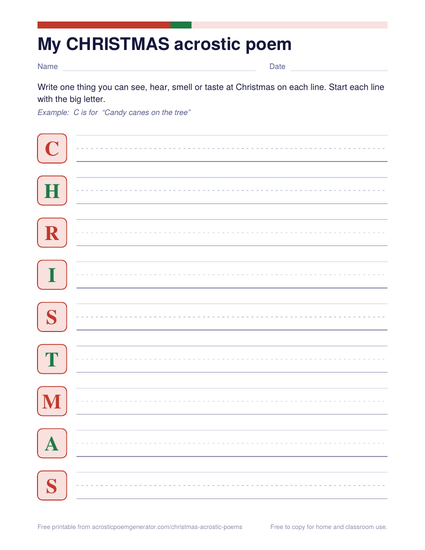
Free printable: CHRISTMAS acrostic worksheet
Two pages, US Letter. Page one has the CHRISTMAS spine ready to fill in, with wide lines for young writers. Page two is blank, for any word you choose.
Download the PDFMore free sheets, including name and all-about-me templates: printable acrostic templates.
Using them in cards and gift tags
Write the spine letters larger, or in red or green, so the word shows before anyone reads the lines. Short spines (JOY, NOEL, SNOW, or the person's first name) fit on a gift tag; save CHRISTMAS and MERRY CHRISTMAS for the inside of a card. A name acrostic on each family member's gift is a small thing that tends to get kept: type each name into the generator, pick Warm or Funny, and change one line to something true about them.
For a funny card, the limerick generator has a Holidays setting. And for winter poems that are not about Christmas at all, see the WINTER poem in the seasonal collection.
How to write your own Christmas acrostic
-
Make a list of your own Christmas
Ten things you could photograph: the ornament with the broken hook, the dish only one person likes, the exact time everyone wakes up. Skip the words that belong on every card: magic, cheer, wonder, sparkle.
-
Choose a spine that fits the list
Three or four details: JOY, NOEL or SNOW. Five to nine: SANTA, GIFTS or CHRISTMAS. Fourteen: MERRY CHRISTMAS, written as a timeline through the day.
-
Let one line go slightly wrong
Half the lights not working, the cocoa too hot, the snowman melting. A poem where everything is perfect reads like a card; one small thing going wrong makes it read like a real Christmas.
Stuck on a letter? The A–Z word lists have openers for every one. Writing for Thanksgiving first? See Thanksgiving acrostic poems.
Questions
What word should I use for a Christmas acrostic poem?
CHRISTMAS is the classic, at nine letters with no hard ones. NOEL, JOY and SNOW are short enough for a gift tag. MERRY CHRISTMAS is fourteen lines and suits a card with room to spare or a poem read aloud at dinner.
What makes a Christmas acrostic poem feel personal?
Swap the general words (magic, cheer, wonder) for things from your own house: the decoration nobody likes, the relative who always arrives late, the food that only appears once a year. Small things going slightly wrong are what make a Christmas poem feel real.
Are there Christmas acrostic poems for kids?
Yes. The children's section on this page has CHRISTMAS, SNOWMAN and ELF written at a five- to eight-year-old level, and the free printable has a CHRISTMAS spine with wide lines.
Can I use these in Christmas cards or a classroom?
Yes. Every poem here was written for this site and can be copied into cards, gift tags, worksheets and displays without attribution.