Holiday collection
Thanksgiving acrostic poems
Eleven original acrostics on THANKSGIVING, THANKFUL, GRATEFUL, TURKEY, FAMILY and HARVEST, three written for children, a free printable worksheet, and an idea for place cards.
Eleven Thanksgiving acrostic poems, all written for this page: THANKSGIVING, THANKFUL, GRATEFUL, TURKEY, FAMILY, HARVEST and a few short ones for cards, plus three written for children and a free printable worksheet. Use one as it is, or keep the shape and swap in the things that only happen at your table.
On this page
THANKSGIVING
Twelve letters is long, so treat the spine as a timeline. This one is the day as the cook sees it.
Two alarms set, the first one for the turkey,
Hands in the bird before the coffee's ready,
Apron borrowed from a grandmother who isn't here this year,
Nine pounds of potatoes peeled into the sink,
Knives handed to whoever wanders through,
Stock on the back burner since Tuesday,
Green bean casserole, the crispy onions saved for the top,
Indoor voices gone by noon,
Vents in the pie crust cut like leaves,
It's too much food. It always is.
Nobody thanks the cook till the plates are clean,
Grace, and then, at last, a chair.
The third line is the one that makes people go quiet. One small absence in a poem full of noise is enough; resist the urge to add a second.
THANKFUL and GRATEFUL
The two most-requested Thanksgiving words, and the two most likely to turn into a list of abstractions: family, friends, health, love. Make every line something you could point at.
The warm side of the bed on a cold morning,
Hot water that comes the first time you ask,
A friend who calls back,
Neighbors who return the ladder,
Kids asleep in the back seat after a long day,
Five quiet minutes with the first coffee,
Unexpected letters with real stamps,
Leftovers, which are tomorrow's dinner already made.
None of these is a big thing, which is the point. A list of small gratitudes reads as more honest than a list of large ones.
Good coats piled on the guest-room bed,
Rolls kept warm in a dish towel,
A seat saved for the late arrivals,
The kids' table, promoted to the real one this year,
Extra chairs carried up from the basement,
Football on mute while someone says grace,
Upstairs, a cousin's baby finally asleep,
Long after dark, the dishwasher's second load.
Every line is something the host did or made possible, so the poem thanks them without using the word. The last line credits the work nobody saw.
TURKEY, GRAVY and PIE
The funny ones. Short spines and food subjects make these the easiest to drop into a card or a group text.
Thawing in the sink since Sunday,
Underdone at two, overdone at four,
Rested, carved, and argued over,
Known to everyone as “the bird” by noon,
Eaten in twenty minutes flat,
Yesterday's, in sandwiches, for a week.
Six lines, six stages in the life of one turkey. The joke is the timeline, not any single line.
Gets made last, in a panic,
Rescued twice with flour and a whisk,
Always lumpy, always fine,
Very nearly the best part,
Yes, there's more in the pan.
The last line is the one everyone at the table has heard. Quoting a real household sentence is the fastest way to make a short poem feel personal.
Pumpkin, pecan, or both, obviously,
In the fridge by Wednesday night,
Eaten for breakfast on Friday.
Three letters, three days. Small enough for the back of a recipe card.
FAMILY and HARVEST
Folding chairs at both ends of the table,
An uncle who brings the same joke every year,
Mashed potatoes passed left, then right, then lost,
Into the kitchen, everyone, all at once,
Late-night pie straight from the dish,
You, across the table, laughing at all of it.
Five lines of crowd, then one line about one person. Ending on “you” turns a family poem into a message for whoever is reading it.
Hay bales stacked by the farm stand,
Apples by the bushel, the bruised ones half price,
Rows of corn rattling, dry and tall,
Vines bent under squash the size of small dogs,
Early frost on the pumpkin field,
Sweet cider in paper cups,
Tractors home before the dark comes down.
A harvest poem for classrooms and fall displays. Every line is something a child could draw.
Thanksgiving acrostic poems for kids
Written at the level a five- to eight-year-old can manage: short lines, real things, and a joke if one turns up. If you are helping a child write their own, ask them to say one thing out loud for each letter before they write anything down.
Thank you for my dog, Biscuit.
He sleeps on my feet.
And thank you for Grandma's pie,
Not for the green beans.
Kicking leaves with my cousins,
Sleepy in the car going home.
Complete sentences, real names and an honest opinion about green beans. This is exactly the level to aim for.
Tail feathers like a fan,
Up on the fence, he gobbles,
Running when the farmer comes,
Keep running, turkey!
Eat some pie instead,
You are safe with me.
Children love taking the turkey's side. The fourth line is the one they will want to shout.
Toys to share,
Hugs from Mom,
Apples to crunch,
New shoes,
Kittens next door,
Friends at school,
Uncle Joe's magic tricks,
Leaves to jump in.
The simplest possible shape: a list. It works because every item is a thing, not a feeling. Use it as a model before handing out the worksheet below.
For more on writing with young children, see acrostic poems for kids, and for a full lesson, teaching acrostic poems.
Free printable Thanksgiving acrostic worksheet
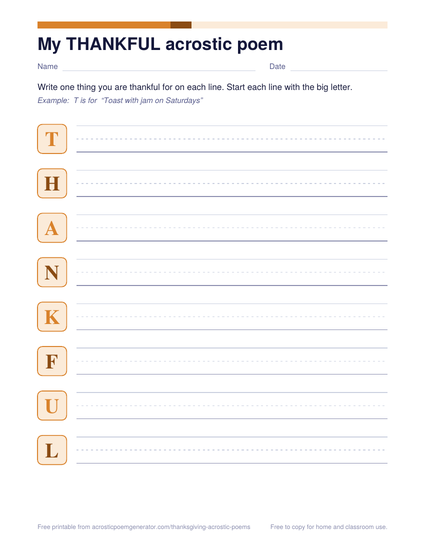
Free printable: THANKFUL acrostic worksheet
Two pages, US Letter. Page one has the THANKFUL spine ready to fill in, with wide lines for young writers. Page two is blank, for any word you choose.
Download the PDFMore free sheets, including name and all-about-me templates: printable acrostic templates.
Thanksgiving place-card poems
The best use of an acrostic at Thanksgiving is not a poem about Thanksgiving. It is a three- or four-line poem on each guest's first name, written on their place card. Short names are easier, and nobody minds if the lines are small jokes. If you have twelve guests and an hour, type each name into the generator, choose Warm or Funny, and edit the result so that every card has one true detail. The name acrostic guide explains how to make a name poem sound like the person.
For something that rhymes, the limerick generator has a Holidays setting, and its Clean level is safe for the whole table.
How to write your own Thanksgiving acrostic
-
List ten things from your own Thanksgiving
Not “family” and “food”, but the actual dish, the actual chairs, the actual argument. Things you can see, hear, smell or taste.
-
Pick the spine that fits the list
Three good details: PIE or JOY. Six: TURKEY or FAMILY. Eight: THANKFUL or GRATEFUL. Twelve, and a lot of patience: THANKSGIVING.
-
Save the quietest detail for the last line
Thanksgiving poems end best on something small and true rather than a big statement of thanks. Let the list do the thanking.
Stuck on a letter? The A–Z word lists have openers for every one. For the other holidays, see Christmas acrostic poems and the seasonal collection.
Questions
What word should I use for a Thanksgiving acrostic poem?
THANKFUL and GRATEFUL are the most popular, and both are eight letters with no hard ones. THANKSGIVING is twelve letters and works best as a sequence through the day. For young children, TURKEY, PIE or THANKS are short enough to finish in one sitting.
How do I write a Thanksgiving acrostic that doesn't sound like a greeting card?
Put one real thing from your own Thanksgiving on each line: the dish that only appears once a year, the borrowed chairs, the relative who always brings the same joke. Gratitude lands harder when it is shown through specific things than when it is announced.
Can children write these?
Yes. Ages five to eight do well with THANKS or TURKEY and one thing they are thankful for on each line. The free printable on this page has a THANKFUL spine with wide lines for that age.
Can I use these poems on place cards or in a classroom?
Yes. Every poem on this page was written for this site and can be copied into cards, onto place cards or onto worksheets without attribution.